Use case · Converged PE + BNG
Provider edge and subscriber edge, one box.
The MPLS provider edge and the subscriber BNG are usually two boxes with a link between them. Netavo BNG runs the full routing stack, so it is both at once: BGP with VPNv4/VPNv6, MPLS L3VPN, per-service VRFs and IS-IS or OSPF to the core, with subscribers terminated straight into the VRF that serves them.
Keeping the PE and the BNG separate means two devices, two configs and a link to engineer between them. Because the routing stack and the subscriber edge live in the same software here, one box imposes and pops MPLS labels, holds the VPN routes and terminates the subscribers.
It peers BGP for IPv4, IPv6 and the VPNv4/VPNv6 address families, runs IS-IS or OSPF to the core, and places each service in its own VRF — business, wholesale, residential — with route targets controlling import and export. ECMP spreads traffic across equal paths.
BFD keeps failover sub-second, and the data plane keeps forwarding through a control-plane restart because shared memory is the source of truth. One device to run, one configuration to review at change time.
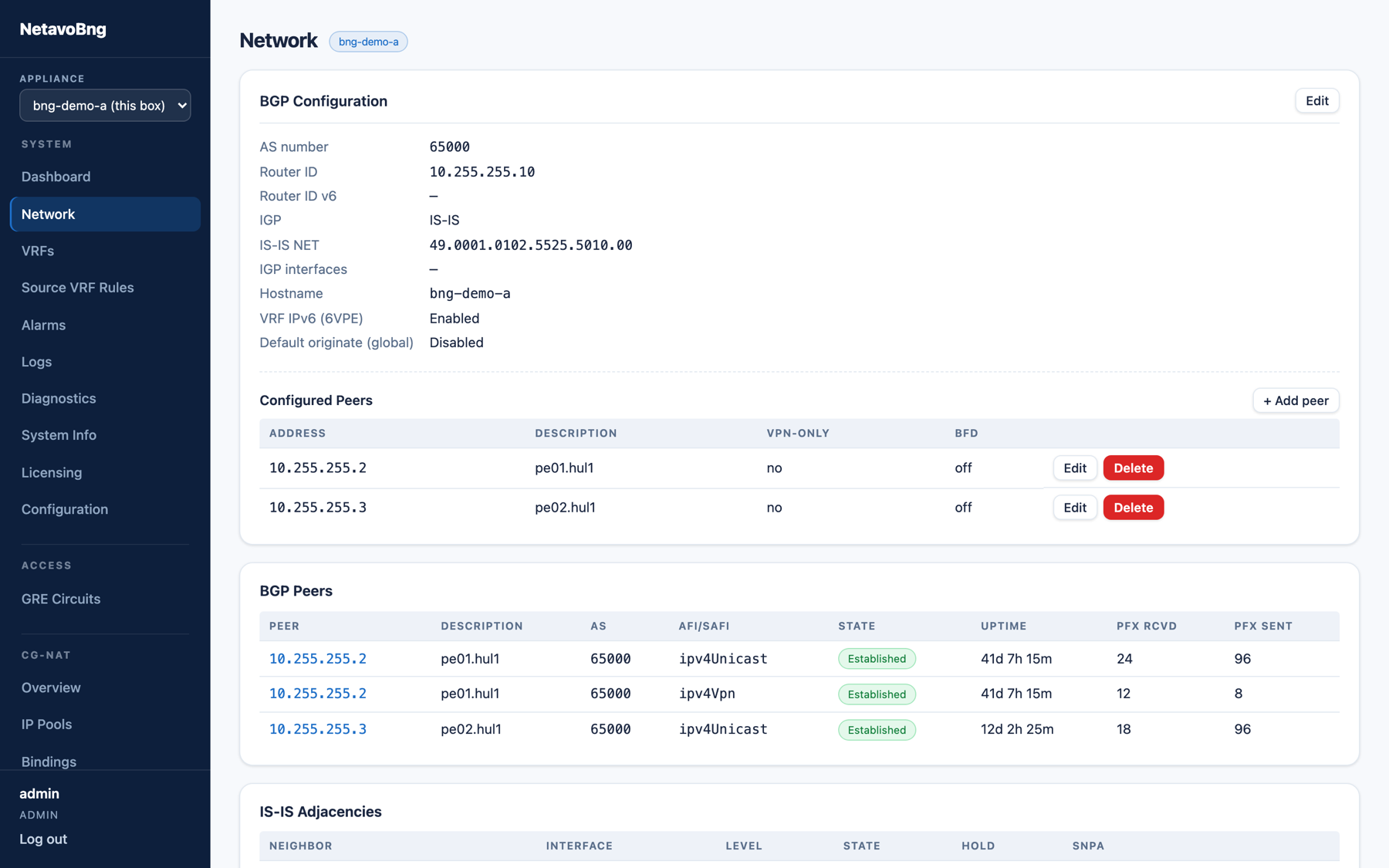
The routing view — core adjacencies, the VPN route tables and per-VRF label operations.
routing names the ASN and router-id, peers the core routers with BFD, runs IS-IS on the core interfaces and defines a VRF per service with its route-distinguisher and route-targets. OSPF is available in place of IS-IS.
Address pools and subscriber sessions reference these VRFs by name, so a line is placed into business or wholesale at termination — there is no stitching between a separate PE and BNG to maintain.
Subscribers reference these VRFs by name, so a line lands in business or wholesale at termination.
IS-IS adjacencies to the core routers, carrying the VPN label space between this box and the rest of the network.
The data-plane label table: each service label pops and forwards the inner packet in its own VRF.
One box, two roles.
The provider edge and the subscriber edge are the same device, so there is no inter-box link to size, no second config to keep in step.
A VRF per service.
Business, wholesale and residential each get their own route table, route-distinguisher and targets, with subscribers dropped straight into the right one.
Standard MPLS L3VPN.
BGP VPNv4/VPNv6, IS-IS or OSPF, label imposition and ECMP interoperate with the routers you already run — this is not a private fabric.
Forwarding survives restarts.
BFD keeps failover fast, and the data plane keeps forwarding while the control plane restarts or upgrades, because shared memory holds the state.
Converge the edge.
Start a free evaluation and peer it into a lab core, or read the routing guide for BGP, MPLS L3VPN and VRF configuration.