Use case · Chassis replacement
Retire the chassis. Keep the subscribers.
The fixed-configuration edge routers a generation of networks built on — the Cisco ASR1000 and its peers — are reaching end of life with no like-for-like successor. Netavo BNG moves that subscriber edge onto commodity x86: the same PPPoE, IPoE and L2TP termination, without the per-throughput licence, on hardware you refresh like any other server.
A like-for-like refresh means another proprietary chassis, another set of line cards and another licence stack — for a platform whose software maintenance is already winding down. The subscriber features have not changed; the economics and the support horizon have.
Netavo BNG terminates the same protocols — PPPoE, IPoE and L2TP as an LNS — with RADIUS, QoS and CG-NAT, on a standard x86 server. The configuration is a single JSON file you keep in version control, not a device-specific CLI dump to transcribe.
The cutover is phased and reversible: stand the x86 edge up beside the chassis, move a pilot hand-off or a slice of subscribers, watch it under real load, then shift the rest at your pace. No forklift, no flag day.
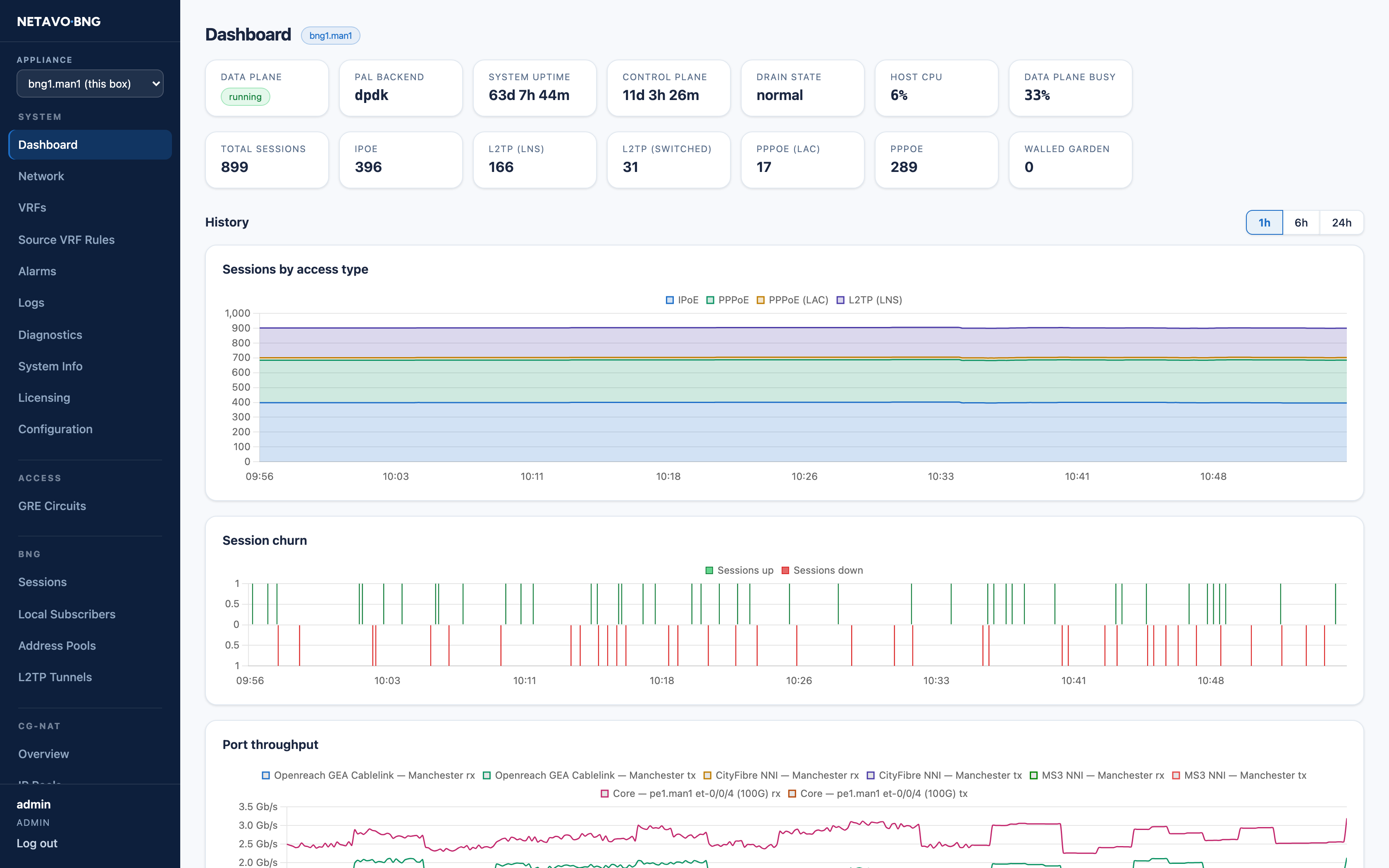
The subscriber edge after cutover — the same lines, now terminated on a commodity x86 server.
| Chassis BNG (ASR1000 class) | Netavo BNG | |
|---|---|---|
| Licensing | Per-throughput and per-feature tiers | None — capacity is an engineering choice |
| Throughput ceiling | Fixed by chassis and line cards | Up to 200 Gbps on commodity x86 |
| Hardware refresh | Proprietary chassis + line cards | Any standard x86 server |
| Subscriber edge | PPPoE · IPoE · L2TP | PPPoE · IPoE · L2TP |
| Carrier-grade NAT | Separate card or licence | Integrated or standalone |
| Configuration | Device running-config | One JSON file, version-controlled |
The subscriber-facing configuration is deliberately familiar: the same access protocols, pointed at the same RADIUS. What changes is underneath — no line-card throughput tiers, no feature licences, and a config file rather than running-config on a device.
The three access roles can run together on one box, so a chassis that terminated PPPoE, IPoE and wholesale L2TP is replaced by a single server, not three.
All three access roles on one box — a chassis that ran PPPoE, IPoE and L2TP becomes a single server.
The replacement is a commodity server — a stock EPYC platform with standard Intel adapters, reported by the box itself.
The same subscribers, re-homed: PPPoE and IPoE sessions live on the x86 edge after the cutover.
No per-throughput licence.
Capacity is set by cores and adapters, not by a licence tier. Growing the box is a hardware decision, not a purchase-order negotiation.
Refresh like any server.
The platform is standard x86 — Xeon or EPYC with Intel or NVIDIA adapters — so the refresh cycle and the supply chain are the ones you already run.
The same subscriber edge.
PPPoE, IPoE and L2TP, RADIUS, QoS and CG-NAT are all present, so the migration is a re-home of subscribers, not a redesign of the service.
Phased and reversible.
Run the new edge alongside the chassis and move subscribers in slices. Nothing commits you until you have watched it carry real traffic.
Plan a chassis migration.
Start a free evaluation to run the new edge beside your chassis, or read the deployment guide for the cutover approach.