BNG & LNS · subscriber termination
Built to terminate subscribers.
Netavo BNG is a broadband network gateway and L2TP network server: it terminates PPPoE, IPoE and wholesale L2TP subscribers — up to 100,000 dual-stack sessions on one standard x86 server. The routing, CGNAT and AAA on the same box are there to serve those subscribers. Every capability below is in the current release, covered by tests, and runnable against the evaluation build.
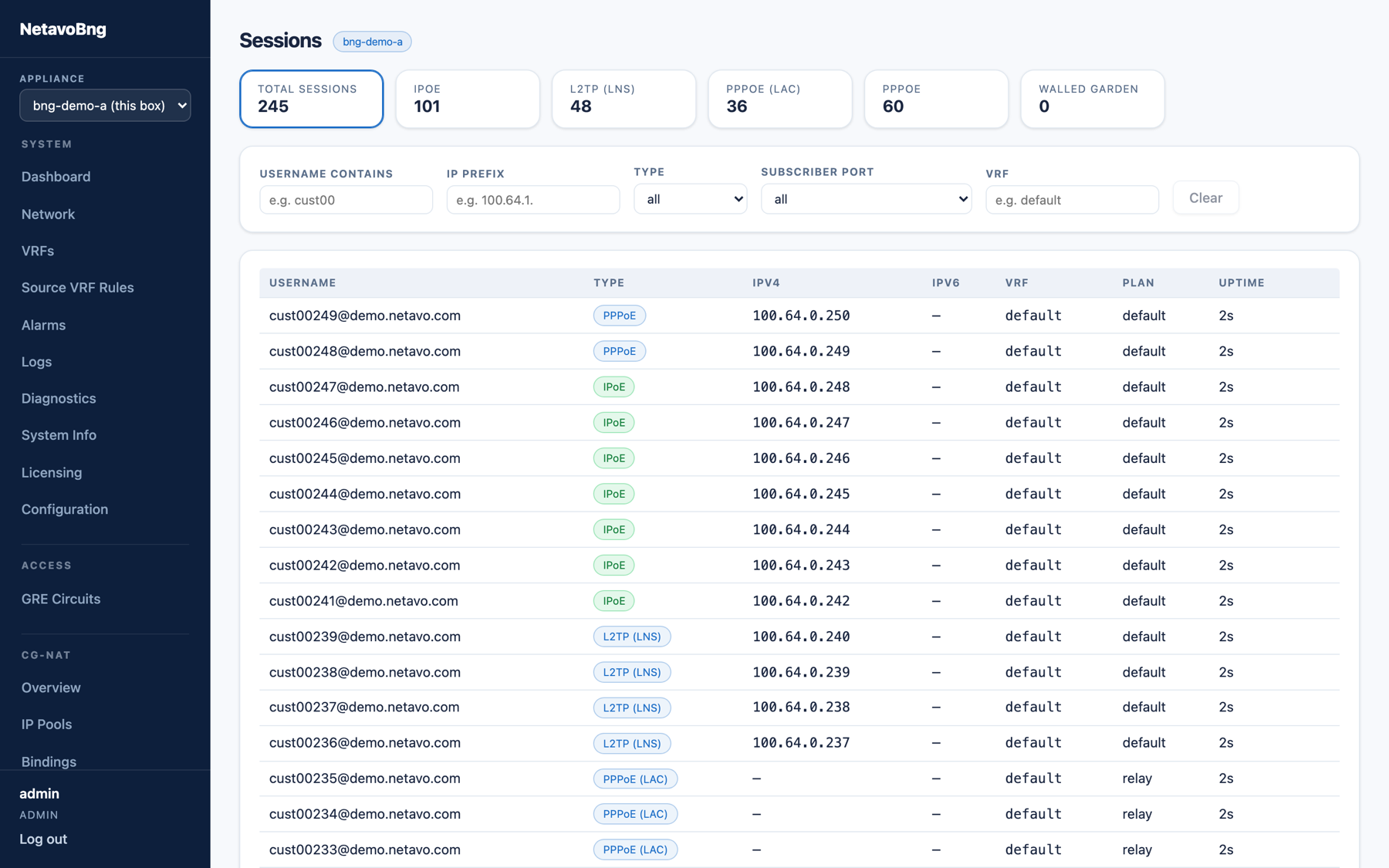
Live subscriber sessions — PPPoE, IPoE and L2TP LNS, dual-stack, one per access circuit.
| Capability | Detail |
|---|---|
| PPPoE server | PAP / CHAP-MD5 · RFC 2516 |
| L2TP LAC + LNS | RFC 2661 · terminate wholesale hand-offs at scale; LNS appliance mode |
| IPoE / DHCPv4 | Option 82 · live-ingest appliance mode |
| IPv6 dual-stack | IPv6CP · RA · DHCPv6 — one session per circuit, both address families |
One subscriber, one session: IPv4 and IPv6 together, with QoS and VRF placement per service plan.
Many software BNGs assume routing happens somewhere else. Netavo BNG carries a complete routing control plane: BGP with VPNv4 and VPNv6 address families, a selectable IGP (IS-IS or OSPF), MPLS L3VPN, per-service VRFs and ECMP. Subscribers can be placed directly into L3VPNs, and the BNG participates in your MPLS core as a full provider-edge device.
Wholesale voice, walled garden, management — each in its own VRF with its own routing. Every entry in the table below is present in the evaluation build and can be verified directly.
| BGP / MP-BGP | VPNv4 · VPNv6 · route reflection |
| IGP — selectable | IS-IS, OSPF, or none |
| IS-IS | IPv4 + IPv6 over one adjacency · level-1/level-2 |
| OSPFv2 / OSPFv3 | dual-stack · per-interface areas |
| MPLS L3VPN | LDP · PE/CE · multi-VRF |
| ECMP | flow-consistent hashing |
A provider-edge routing table on the subscriber gateway — VPNv4/VPNv6 peers and per-VRF tables.
| Per-subscriber QoS | rate limiting per service plan · TCP MSS clamp, all paths |
| CGNAT (NAT44) | included in every licence · port-block logging (RFC 5424 JSON / Service Bus) · EIF for gamer-friendly NAT · sticky public-IP affinity |
| Lawful-intercept readiness | interception primitives and mediation-vendor integration; we do not claim an in-product ETSI stack |
fig 4.0 — the forwarding guarantee is structural, not aspirational
Session state lives in shared memory. The DPDK data plane reads it directly and keeps forwarding whether the control plane is up, restarting, or mid-upgrade — the same property that makes our licensing enforcement incapable of touching traffic.
Deploys as a self-contained software appliance on standard x86 servers. Hierarchical CLI with commit and rollback, web UI with two-factor authentication, structured JSON syslog, database or RADIUS authentication, and accounting to RADIUS or Azure Service Bus.
Candidate configuration with commit and rollback. Changes apply to the data plane in place.
Is a BNG the same as a BRAS?
Yes. BRAS (broadband remote access server) is the older name for the same function, from the DSL/PPPoE era; BNG (broadband network gateway) is the term the industry standardised on as the role grew to include IPoE, carrier-grade routing and integrated services. Netavo BNG is a software BNG — the gateway a BRAS provided, on standard x86.
Does Netavo BNG route as well as terminate subscribers?
Yes. It is a converged PE/BNG: on the same box it runs BGP with VPNv4/VPNv6, a selectable IGP (IS-IS or OSPF), MPLS L3VPN and EVPN, per-service VRFs and ECMP, so the BNG is a first-class provider edge in your core.
What hardware does Netavo BNG run on?
Standard x86-64 servers. There is no appliance lock-in and no per-core or bandwidth licence tier — the licence axis is subscribers only, so moving to a larger server forwards more traffic without a licence change.
From our engineering notes
What is a vBNG? Virtual BNG, software BNG and CUPS compared
A vBNG runs the broadband network gateway as software on x86, often in a VM. Here is what the term covers, how it differs from CUPS, and when a VM is the right home.
ReadReplacing a chassis BNG with software on x86
Plan a staged migration from an ASR9000, 7750 or MX to a software BNG, with checks for subscriber policy, routing and failure behaviour.
ReadHow far does a software BNG scale? Sessions, throughput and the real limits
Netavo reaches interface line rate at IMIX on commodity x86. What actually bounds a software BNG, and the numbers behind the claim.
ReadPPPoE vs IPoE: what IPoE is, and choosing an access model for FTTP
IPoE carries subscriber IP straight over Ethernet with DHCP; PPPoE wraps it in a PPP session. They differ in line identity, overhead and trust. Here's how to choose.
Read